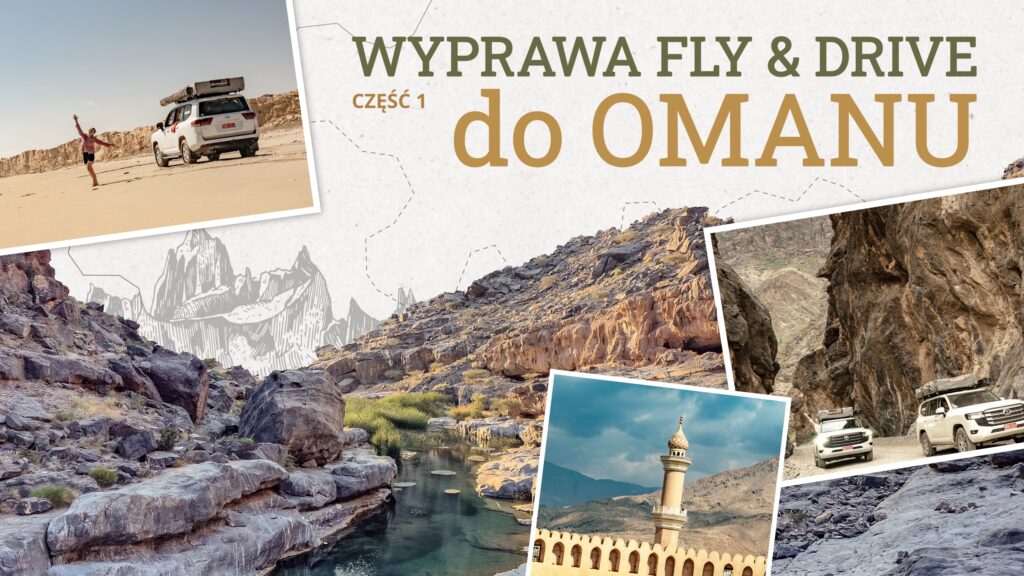
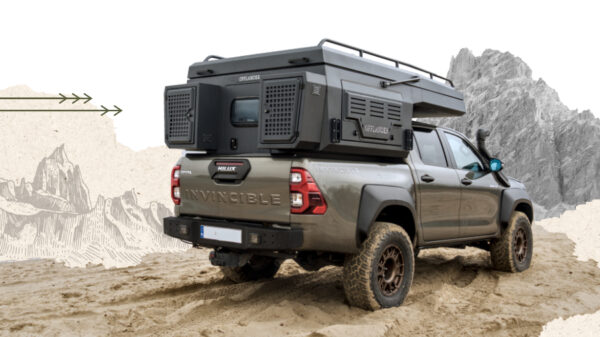
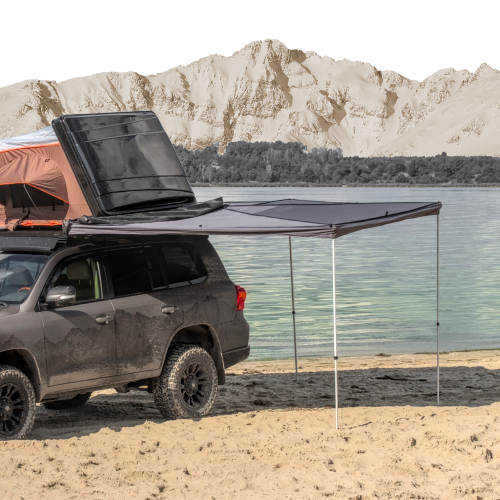
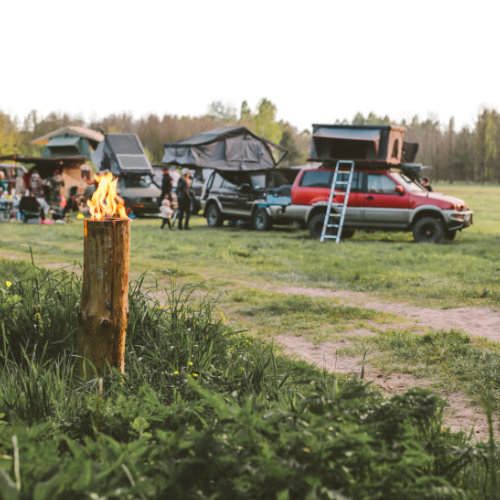
Oman made a huge impression on us. Not only is it geographically very diverse, the temperatures are very pleasant during the grey Polish winter, but it is also very safe, clean and tourist-friendly. Especially in terms of wild camping. Because that’s the option we chose, of course.
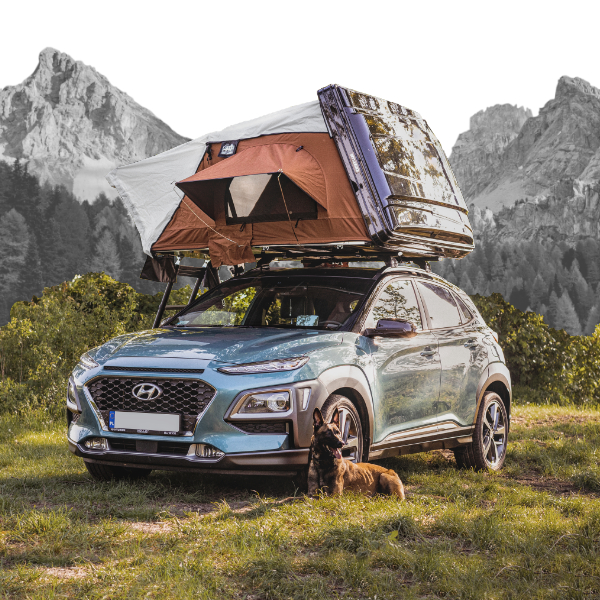
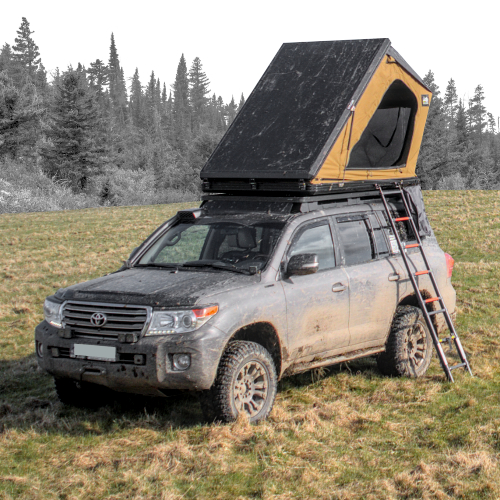
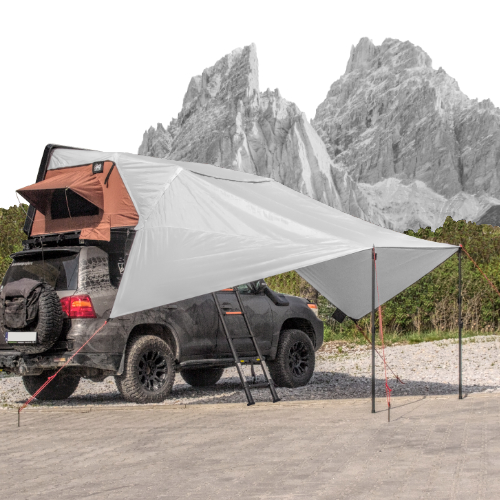
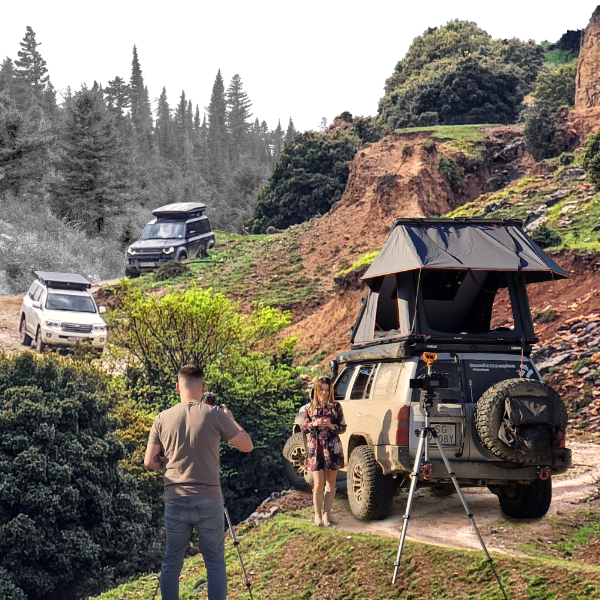
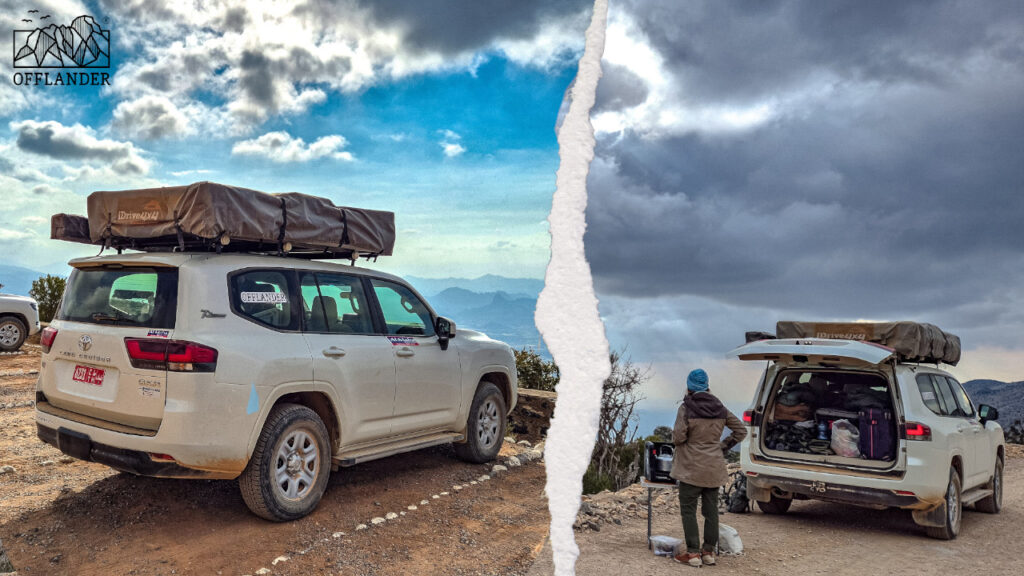
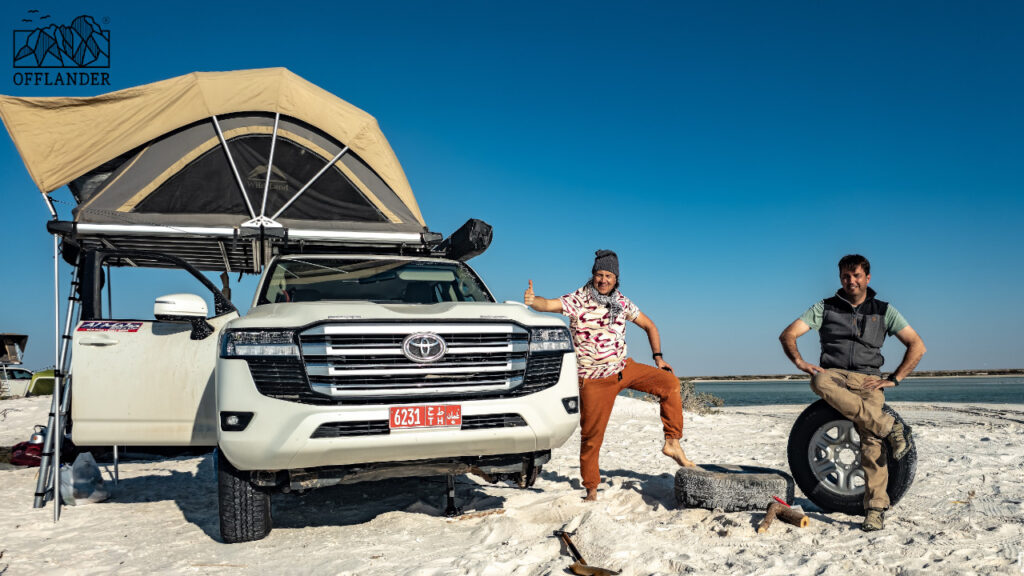
We spent over two weeks in Oman traveling in large white Toyota LC300s with a tent on the roof and camping equipment packed in the trunk, alternating with suitcases. Everything mixed with everything. Our group was just three families, two plus two. Some more, others less experienced in travel battles. We went without a guide, without a purchased tour and an organized group. Despite a well-planned route and many months of preparation, we were forced to give up many places and attractions that this beautiful country offers. As always, there was simply no time. As a guide, I struggled every day with the thought of whether it was worth going here or there. Isn’t two nights in the desert too much, or if it rains, it won’t simply wash us away in one of the Wadi. Why the constant question: will it be as beautiful there as here? Will everyone rejoice in spirit as much as I do? The answer is simple and obvious. But after the fact. At the expense of quantity, we used quality. Short days in winter, as always during this period, took away precious moments that we could exchange for valuable experiences and later memories. Our individual treasures. We often decided not to rush to the „next” but to enjoy the current one. It certainly wasn’t easy, because the country is very vast and there is a lot to travel through and experience. I am always tempted, as I am sure you are, to see more. Such a cursed traveler’s greed, but sometimes I realize that more doesn’t mean better. That we should enjoy ourselves now and not in the future. Such decisions had a very good influence on the course of our trip. More relaxation wherever possible. Despite everything, we finished the expedition together, just two families. We did over 2500 kilometers, mainly on gravel and sand. We slept in the mountains, numerous Wadi, in deserts and various wonderful beaches of different colors. We drove on beaches that were flooded with salt water a few days later. We swam in the turquoise ocean of white lagoons, walked through the mountains and valleys. We observed turtles, birds, goats and camels, the customs and habits of the natives. We got to know countless different rocks and stones, in terms of colors, formations and shapes, because Oman is over 70 percent mountainous, contrary to appearances. We bathed in hot springs and icy mountain water. We visited oases and groves. We buried ourselves in the desert, buried ourselves on the beach. Despite the lack of wood, we had a beautiful and large bonfire every day, which still forced us to sleep around 8 p.m., out of pure exhaustion. On the other hand, we greeted the day every day with sunrise just before six a.m. I think these moments are the most wonderful, it’s like a clean new page waiting to be filled with something interesting.
I will largely ignore the issues of preparation, which are significantly different from trips “on wheels” or organized trips. In our own car, we already have our own standard and throw in as much as we can. In organized trips, we can always count on the organizer to take pity on us, lend us something. Limited by the luggage limit, we pack too much. After arriving in Muscat, after the first transfer of four twenty-kilo suitcases, I knew we had a problem. My son had a pair of pants for the day… and a T-shirt and a sweatshirt. It was fourteen days. I took too much equipment in the car, it weighs the most.
After arriving in Muscat, we are greeted by palm trees, dry warm air at a temperature of 27 degrees, lots of sun and the first smell of sweat from under many layers of clothes and warm jackets. We are also greeted by a card with my name, an escort to the car park, arranging currency and internet cards. Everything was quick and efficient, at least that’s how I remember it through the fog of tiredness.
We quickly search the cars we pick up, quickly throw out some of the equipment. The big pillows as hard as a haystack quickly fly out of the boot. This gives us room for suitcase number three. Now the big pots, pans, barbecue and other relatively unnecessary things, such as the fourth sleeping bag the size of suitcase number four, are thrown onto the pavement. Everything has to fit, including our children and the fridge in the form of an ice tank. And we squeeze everything into the new Land Cruiser 300. It still shines with its white velour and here and there shamefully shows the factory foil. Mine had only ten thousand kilometers on the clock, a new and hungry four-litre engine in petrol, lots of beeps and reminders. We also had a black sheep, a Toyota with a diesel engine, which gave up the ghost at the end of our trip, through no fault of ours. And it fell to Mariusz, who despises diesel. Such a joke.
We spent over two weeks in Oman traveling in large white Toyota LC300s with a tent on the roof and camping equipment packed in the trunk, alternating with suitcases. Everything mixed with everything. Our group was just three families, two plus two. Some more, others less experienced in travel battles. We went without a guide, without a purchased tour and an organized group. Despite a well-planned route and many months of preparation, we were forced to give up many places and attractions that this beautiful country offers. As always, there was simply no time. As a guide, I struggled every day with the thought of whether it was worth going here or there. Isn’t two nights in the desert too much, or if it rains, it won’t simply wash us away in one of the Wadi. Or maybe the constant question: will it be as beautiful there as here? Is everyone as happy in spirit as I am? The answer is simple and obvious. But after the fact.
At the expense of quantity, we used quality. Short days in winter, as always during this period, took away precious moments that we could exchange for valuable experiences and later memories. Our individual treasures. We often decided not to rush to the „next” but to enjoy the current one. It certainly wasn’t easy, because the country is very vast and there is a lot to travel and experience. I am always tempted, as I am sure you are, to see more. Such a cursed traveler’s greed. With time, however, I realize that more does not mean better. That we should enjoy now and not in the future. Such decisions had a very good influence on the course of our trip. More relaxation, wherever possible. Despite everything, we finished the trip together, just two families.
We covered over 2,500 kilometres, mainly on gravel and sand. We slept in the mountains, numerous Wadis, deserts and various beautiful beaches of different colours. We drove along beaches that were flooded with salt water a few days later. We swam in the turquoise ocean and white lagoons, walked through the mountains and valleys. We observed turtles, birds, goats and camels, the customs and habits of the natives. We got to know countless different rocks and stones, in terms of colours, formations and shapes, because Oman is over 70 percent mountainous, contrary to appearances. We bathed in warm
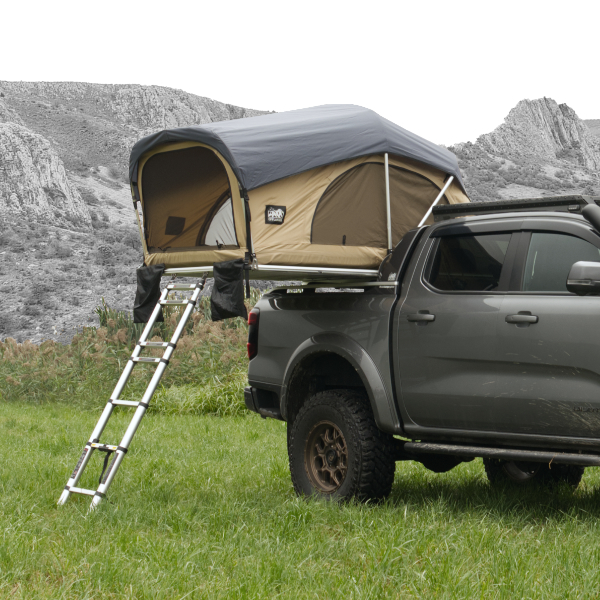
Old, this set included only tents. Rag, large, with a super-hard mattress. Palaces, where we will spend most of the nights in Oman. The first night in a hotel, however, here we leave one full, repacked suitcase and one empty one. This gives us a bit more freedom when traveling, but I definitely miss my Offlander organizers, the building and, above all, the Fold 4 tent. Although smaller, it is more comfortable.
There is nothing to complain about, we have good weather. Everyone is healthy and ready to take on a new challenge and we have – fortunately – the worst plane journey behind us. We also have a well-prepared route, a day-by-day plan and, at first glance, a well-coordinated team.
First Wadi
A few years ago I was in my first Wadi in Jordan. I had my own idea. Narrow, high, pointed cracks sunk in the ground. A difficult trail that required climbing and getting wet. A lot of rubbish and little water. It’s different here.
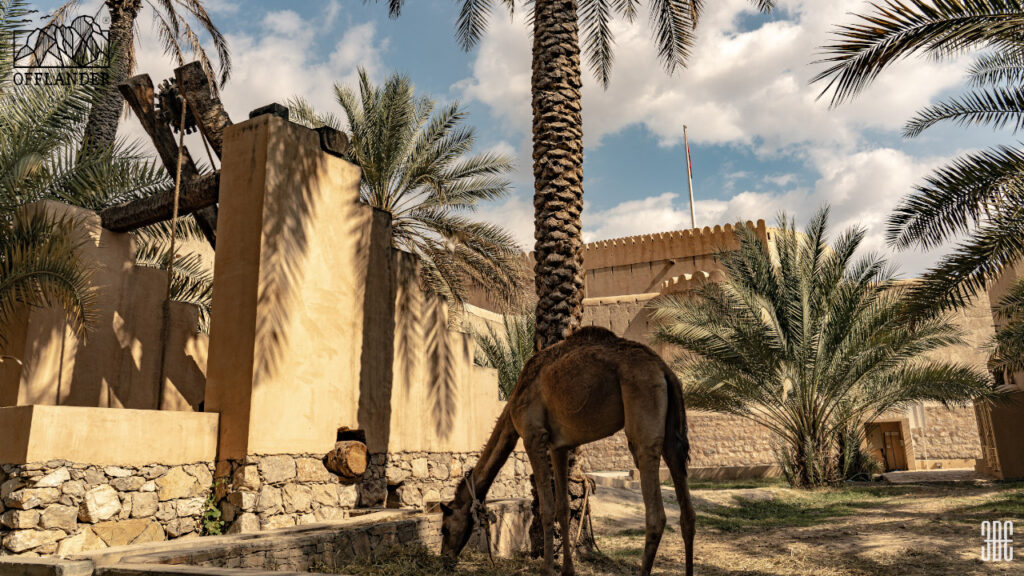
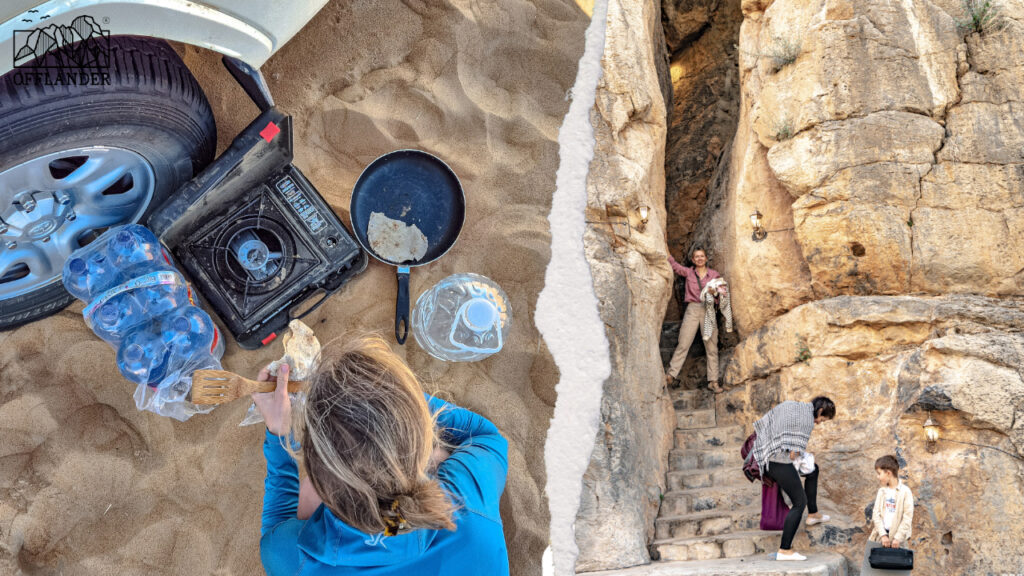
On the first day we head for Wadi Far. We don’t start until eleven from the hotel, we have to get there for a while. We learn a bit that no one is in a hurry here, especially in the middle of the day, when the sun is shining down from above. It’s good that it’s winter. First we visit the Nakhal Fort, where we wander in the southern sun, drinking the first good Omani coffee. We admire the first large, pointed minarets of mosques and the grove that wraps the fort from the mountain side. The Fort itself is in great condition, raw, monochromatic but interesting at the same time. Apart from that, there is still asphalt and civilization everywhere. We also stop at the nearby hot springs and gather towards the village of Wahau. There we start to get to know the first face of the mountains and climb the first gravel roads. In the village, which is really a village, we have a few houses on the cross. Parking, toilets for tourists and one restaurant with 5 tables. There we decide to have dinner. Chicken, lamb and rice are the basis of our first meal and most dishes during the entire further journey. A mixture of rice and meat originating from Indian cuisine called Biriani will often be present on our plates. We ate it on the floor in local restaurants, on plastic oilcloths with local fishermen. We ate it from cardboard packaging, we ate it by the fire as take away in roadside pubs. It was always good and perfectly seasoned. Eastern cuisine is very rich in spices, it is a pity that Europe is so careful about them, often replacing them with fatty oil and some kind of filler that is flat in taste.
On the first day I modify the route, we won’t make it to the campsite in Wadi Far, and certainly not the way I had imagined it. We return from Wakan to the north, making a light and fast gravel ride instead of asphalt. It’s beautiful, around us are already brown rocks in the mountains, grey gravel carefully arranged in winding bends in the valley and that beautiful setting sun. Time is running out, the first campsite in the dark? Well, almost.
Is this a Wadi? Three hundred meters or more wide, flat and rocky like a gravel pit. A negligible amount of water, at least that’s right. Here and there grow palm trees, tufts of tall grass. Wadi Far winds and narrows more and more, surprisingly towards the water outlet. We quickly charge north towards its other end. We look for the first campsite among the palm trees. They will give us shade in the morning, in the evening they will serve as a secret base for our children and at the same time we will burn their dry branches with other wooden waste on the fire. It is warm and pleasant. There are a lot of stars in the sky and peace.
In the morning, we have many pleasures of the mind and body. I start with a walk into the depths of the Wadi, Ewa practices yoga. The children sleep off the evening excesses in a secret palm base. We swim in the deeper parts of the river, refreshed and packed, we divide into two groups. And so it will remain until the end of the trip. Mariusz and I stick together and start by going crazy on the way back, splashing clean water with momentum and a local scrape of the chassis against the river stones.
Snakes
We continue towards the Rustaq fort, which is closed, as are the nearby hot springs. Maybe it’s a good thing, because it would be the same scenario as the previous day. We waste the rest of the day having coffee opposite the deserted fort. Here we deepen our knowledge of expats and the population of Oman, why Omanis look like Indians and why their coffee is so good. Then we shopped in local shops, refuelled and tasted Pakistani takeaway. I have to admit it was a bit of hell, I won’t say where.
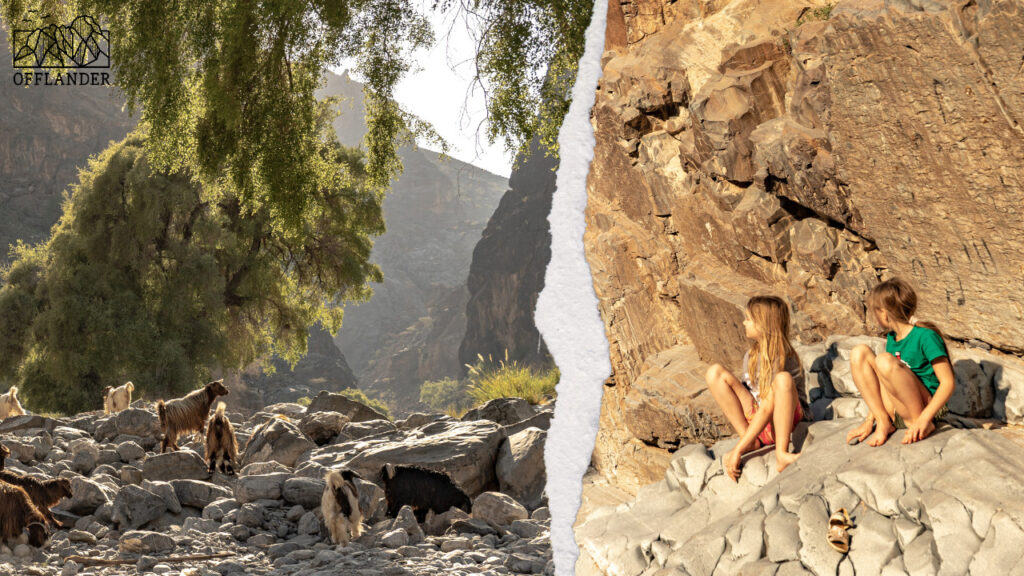
The next stop is the Little Snake Valley, also a Wadi but completely different. We arrive from the trekking side through beautiful mountains. The entrance from the asphalt road is quite dramatic, because the mountains rise immediately, formed like large storm waves directed in one direction, tilted, menacing and multi-layered. The road quickly turns into gravel and remains that way for the next few days. For some reason we gave up climbing in the Wadi, wading and scrambling over rocks. Instead, we choose to rest on the charming other side of the valley, where we spend the rest of the day camping and bathing in the icy water. Most of the time we spend chasing off the local goats, who were chasing each other furiously on the rocky ledges. Our children picked up on this and now we had the picturesque Little Snake Valley, who were yelling at each other. I quickly run away for a walk.
The mountains surrounding us are very diverse. The colors of faded brown, gray and beige reign supreme. In various forms and shapes. Most of them are tilted to one side, as if they were once waves of a rocky ocean. Now they are frozen, left for thousands of years, especially for us to admire. I climb a sharp trail that I marked out for myself, maybe a little bit following the goats’ trail, a little bit just uphill. It will be dark soon, we have set up our camp today right at the end of the road, about five hundred meters from the lake and the mouth of the Wadi. I start to wonder if we won’t be washed away during the night, the sky is overcast and increasingly grey, there are no stars at night and all possible slopes lead towards our tents.
The next morning the weather is no better, the sky is overcast and its greyness merges with the mountains on the horizon. After the morning activities of breakfast and walking we pack up the camp and head towards Al Hamra, Christmas Eve dinner. On the way we still have trekking in the valley of the Big Snake. Unfortunately we didn’t go very far there. The wadi is cut out of the towering mountains with a cleaver in the shape of a water slide. After only thirty minutes we are standing at the precipice above a pool of clear and icy water. All a few dozen meters below us. Although the children were already soaked to a greater extent, we decide not to go any further. There would be no going back.
We start to fight against time, the road ahead of us is longer than I expected. The kilometers on the map do not reflect the difficulty of the route. We drive all day in heavily ground brown flour, which was produced by a few vehicles moving on stone paths for countless times. It sticks well to cars, changing the white color of the bodywork into various shades of beige. Flowers, hearts and the word KOK also appear, painted with the fingers of our children. Although KOK probably came out of the mind of an adult. KOK will be our guardian angel until the end of the trip.
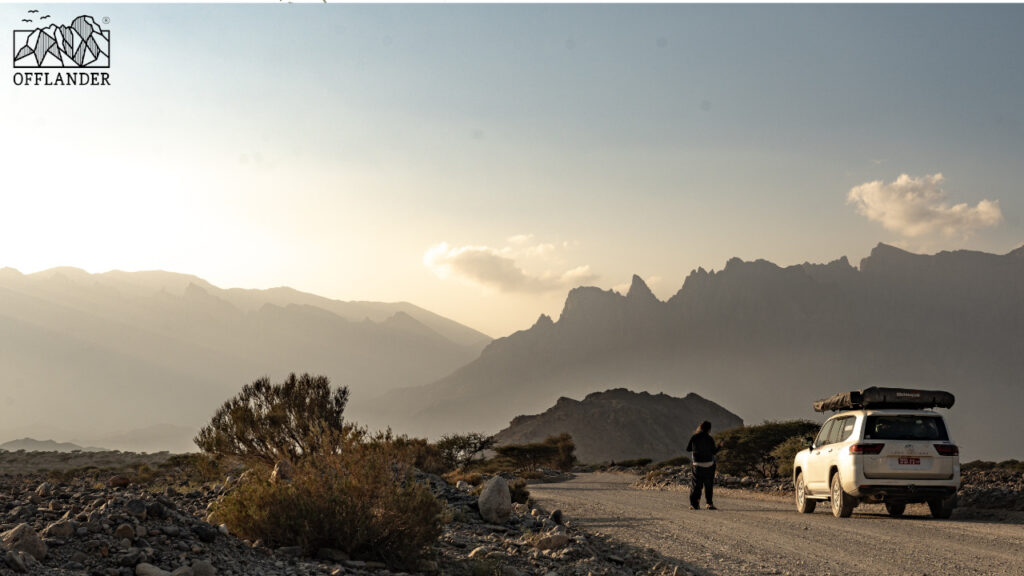
Despite the still cloudy sky, the views are sky-high. The scale is enormous, sometimes we are unable to tame the distance, the size of the peaks and mountain ranges. For example, first we see a bright thread that cuts through these huge, endless masses of brown chocolate mass, solidified millions of years ago. Then we are part of this thread, which is our road beaten from beige flour. Where the slowly setting sun breaks through the clouds, creating bright clearings in the sky, revealing bright spots on the vertical mountain slopes.
The number of bends, climbs and descents does not affect us all too well. Especially the children, Basia is already the norm, we know that she will feel sick. Well trained, she tells me when to stop, does her thing, shakes herself and we drive on. Bruno, on the other hand, decided to handle it in silence. Rushing through the last stretches of the road, no longer paying attention to the holes and the creaking of the entire contents of the trunk; so that we can make it to the night, the open door light comes on, then quickly goes out. I immediately go crazy, Bruno has tampered with something again. He is playing with the door. I look in the side mirror and see my son with his head sticking out the window. With a pale face, with cheeks filled like a balloon, he asks as if for permission. I nod my head mechanically, he releases a colorful balloon of the entire day’s contents. He closes the window. We were all speechless.
Arab Christmas Eve
The next few days we sleep in hotels. The first one was deliberate, for Christmas Eve. It was hard to predict the weather in the Jabal Shams mountains. With peaks reaching 3000 meters and the current weather, we were in for two of the coldest evenings. So, it was a good thing.
Our hotel is quite a view, literally and figuratively. The name The View meant little to us in the evening, because we arrived when the sun had already hidden behind the mountain peaks. In the morning, however, the sun illuminates the labyrinth of stairs, terraces and paths on the mountainside. With a view of part of the Jabal Shams mountains and the city of Al-Hamra. These paths and terraces connected individual rooms, which were made up of the shape of a sea container. Each room was a single container. Very interesting.
Christmas Eve was a cultural conglomeration in terms of food and guests. We had Dutch, French, a few Germans, English. The rest of the standard was Indians and Omanis. No carp, no dumplings. There is hummus, octopus, guinea fowl, shrimp, rice, fruit and various sweet delicacies.
In the morning we will have a beautiful view, a good breakfast, yoga by the pool and a quick evacuation. Today we head towards the cliffs of Jabal Shams, which supposedly fall vertically down about 500 meters. That’s what it says in the guidebook, in reality it’s impossible to say. For me there is much, much more, because looking down makes me dizzy. Ewa is afraid to go within ten meters of the edge. Jabal Shams is one of the most beautiful and largest canyons I have ever seen. No wonder it is called the Grand Canyon of the Middle East. I regret a little that the weather is changing to cloudy again, limiting the visibility and sharpness of this beautiful view. The road, just like the weather, is complicated, demanding, but at the same time spectacular. At the end of the day, Wadi Damm awaits us in the warm golden sun, which has finally decided to disperse the clouds. This Wadi, like any other, is different. We park our cars at the wide mouth of a canyon, which with its smooth and high walls cuts into the terrain. At first very wide with an artificial dam, later with increasingly intricate paths, ending around the bend with open pools and cascades. Well, yes, the sunset is beautiful, but now we have to get to Al-Misfat. The navigation says that we have over an hour and a half to go, the light is ending quickly, we are hungry, we are quickly lost. It did not take much for what I feared most to happen. Dusk, no signal, no CB communication and no visual contact. If something happens, everyone has to cope on their own. Of course, we do not pass anyone on the road throughout this section, because it is some forgotten road. Krzysiek disappeared first, I chase Mario. Mario takes a wrong turn and I end up chasing a ghost. The national road is gravel crossing the nearby mountains, basically no changes, today the whole day is mountains and gravel crossing them. In the end, I arrive first at the hotel, being the last one to start. It is dark, the roads are very narrow in the town.
The hotel is very nice, being the tallest building in the old town of Al Misfat, which itself is a maze of old buildings, which are connected by narrow streets and stairs up and down. The settlement is situated on a rock, which certainly acts as a natural fortification. In addition, the houses are made of mud, stone and saruj.
The next day we will discover the oasis and the water canal system, called falaj, which is over 2000 years old. It is still used to supply the village with water from the spring and to irrigate the terraced fields where crops such as mangoes, pomegranates, figs and olives are grown.
Our hotel is a mishmash of stairs of various shapes and lengths, each room is a little different. We get the corner one with a bathroom where you can take a shower sitting on the toilet. All in all, it saves a lot of time. But we definitely have a better view, because Mario has windows onto the main staircase, so we often wave to him when going up and down the main entrance. Others wave to him too. The children have rooms in the new part and they look a bit like interrogation rooms. The hotel’s biggest asset was its terrace, which in the evening glowed with bright fluorescent lights, giving us a full picture of a rather simple dinner. There was hummus and pancakes, rice… something else, it was enough for me. There was also an intervention, we can’t afford to be separated from the group like that and potentially dangerous. We disperse with understanding. Later we also understand that we didn’t understand anything.
Colorful pictures
The next day we rush to Nizwa, one of the larger cities and a large tourist fort. This time on asphalt. Of course, we won’t miss racing Mario on the two-lane suburban roads. Diesel vs. petrol. I push my petrol-powered microwave with a roof tent to its limits, but the little bits coming out of the two turbos and the 3.3 engine win in the long run. It costs us a few tickets, each with the highest rate of exceeding the speed limit by thirty kilometres per hour or more. It’s a good thing the tickets don’t come until a few weeks later, so we keep racing to get another one or two.
Nizwa is an interesting stopover, we buy a few souvenirs there and, outside the fort, visit the old souk, the local bazaar. We also meet Krzysio and his family in the same restaurant, by accident. Actually, since yesterday’s conversation, we’ve been disconnected since morning. At dinner we make a plan that we can’t hang up anymore, because we have a desert crossing ahead of us, because we need to stock up, buy wood for two or three days, ice, water, fuel, etc. We can’t hang up either, because we only have one compressor, one set of rope with shackles and three walkie-talkies that no longer work. What’s more, we can only charge them from a 220V socket. Perfect. Krzysiek also has our frying pan.
So we hang up quickly. Already in Nizwa. A quick calculation says that we will reach the desert after dark, I decide to go look for wood and do some shopping. I know that Mario will turn on the overdrive with the PWR button and catch up with me. I wonder how many tickets he got that he didn’t admit to. Together we reach the gates of the desert, namely Badiya. There we take care of the shopping, wood and hide our tiredness and hunger. The desert greets us in the dark, we see flashing lights of approaching cars in clouds of dust, someone accosts us, someone offers us guidance to some great campsite. We decline, deflate and look for our first night’s lodging, as far as the disappearing mobile signal allows us.
But where is Krzysiek? Distracted by colorful paintings, still in Nizwa, in a restaurant gallery, or so we joke later, he gets lost. He was brought to us by some Omanis, whom they met in the dark in the desert, thank goodness for them. In the meantime, I get to know for the first time the shortcomings of the car without modifications, I dig myself in and make basic mistakes. Fatigue is taking its toll, we don’t go any further, here it is „good enough”.
Once we’re all together, we light a campfire. At first, it’s windy and we can hear a lot of cars coming back from the desert to the town. We haven’t really gone far, two hills from the main road. A moment later, both the wind and the cars stop. We have a starry sky above our heads and a small glow from the nearby town. In addition, our shadows dance to the rhythm of the small campfire. We also have little friends. They are desert mice, or rather, I think there’s only one. A tiny one with big ears, runs between our legs, not afraid at all. She often runs up to the campfire and looks into the flames, so I can see her snout well and two small black coals that blink from time to time. We all squeal with joy like little mice.
In the morning, there are her traces everywhere, her little face was running around. There’s sand everywhere too. Everywhere. Now it dawns on us that we’re in the desert, because at night there was only a dimly lit section in front of the car’s headlights. Of course, Ewa and I are going to see the sunrise. At first, not really, of course, because we feel tired after the whole previous day and a sleepless night. We would like to sleep. In addition to strong will, our bladder mobilizes us a bit. We head towards higher dunes, from where we have a priceless view of the valley and another range of high dunes. Later we know that this is how the entire desert is shaped, cut along by sand canyons. Tomorrow we will try to break through to the south many times, without much success. Sunrises in deserts are some of the most beautiful. The changing colors of the sand from gray to warm brown. Then gradually into molten gold, to later shine with a blinding silver glow. At night, being a black abyss.
Wahiba Sands
Now it is actually called Sharqiya Sands, because Wahiba is the name of the people who live here. However, I like the first name more and that is how it is engraved in my memory. The Wahiba Desert, like this pickup truck.
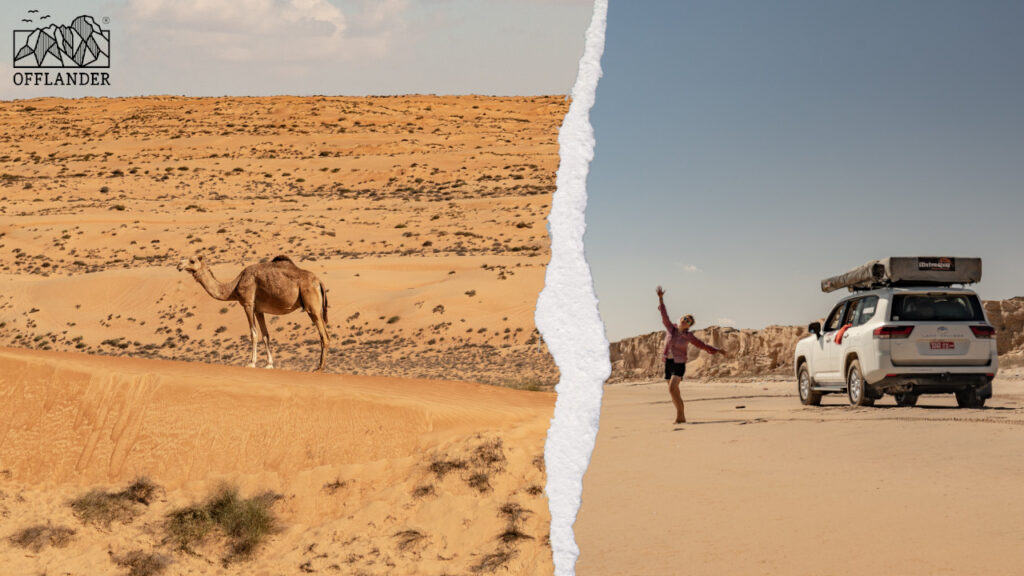
Deserts have something about them and I always feel drawn to them. This time it is the same. It is probably the vastness in front of me, both left and right. The same. The feeling of fear that you can get stuck here, without water, for example. However, this one is a bit different from the ones I have been to. Apart from the fact that it is cut quite regularly by sand canyons, which can be seen on satellite photos and maps, it also offers a few surprises. One of them is a mosque in its very heart. And not just any mosque, a roof decorated with gold, a soaring minaret, surrounded by a wall, shining majestically in the sun. We also came across several luxury campsites and numerous smaller, deserted-looking huts. We often saw camels, both wild and tethered, and we also saw them in the backs of local Toyota 79s. They stuck their calm heads out over the cab, chewing something
and glaring at us as we dug in the sand.
Most of the day we tried our hand at breaking through to the next canyon, but it required climbing high dunes. They defeated us quickly and effectively every time. Even when we thought we had broken through to the other side, it turned out that there was another one waiting for us. A mirage. While we were digging with shovels, our children took turns sliding down one of the dunes on a „sandsurfing” board, we heard squeals and cries of children’s delight.
The sun quickly squeezed the last sweat out of us and at about 4 p.m. we ended the day almost at the other end of the desert. Here the dunes were lower, the desert was already covered with some bushes. We encountered more animals, including goats, sheep and even a few cows. We all have red snouts, burnt necks and feel tired. The desert drains all energy. We experience another windy night with stars arranged differently than in Poland. The Milky Way is more visible, against the background of the totally
black abyss of the sky. This time without any glow.
Kites
I’m taking two kites to Oman, that was actually an ambitious plan. Well, yes, but why the kites? It’s a cunning and sly plan straight out of „Neighbors”. Due to the fact that in Oman flying a drone is not allowed, or is severely limited by documentation and permits. I decided to connect a 360 camera to the kite and let it fly. The stabilization built into the camera will eliminate shakes, while the 360 image will allow you to cut out a specific frame. That’s what a drone gives us, but differently. Smarter. More cunning. I’m proud of my plan. I can even see how we pull it behind the car, on a special super-resistant accessory line, which I bought, of course. It started with one kite not fitting into the luggage, so I focused on this for the kids. Uncomplicated, simple and anyone can do it. That’s what the ad said. After an hour of fighting with the ropes, Bruno and I gave up. My discouraged son went to dig mouse holes and I went to dream how wonderful it would be to have a drone. The views in Oman
are simply amazing, maybe next time.
In the morning we realize that we are running out of food. Fortunately, today we only have a dozen or so kilometers to the coast, where there is a fishing village and one town, where there are definitely shops. And not just any shops. They have crisps sold in bags of 10 packets, there is washing powder, there is cola, there is water, there is even some food in the form of dry soups, packaged bread-pancakes. Everything is in great disorder on twenty square meters, in a town that is very poor. Every house is fenced with a wall, there is a lot of garbage and disorder. It is a great contrast to what we saw earlier. I slowly understand that the map does not lie. This is where civilization simply ends and nothing begins. Either you have to go north or wade into nothingness south. We choose the south.
On the way to the town with shops, we spontaneously go down to the coast. Apart from a short episode in which I managed to get buried again, it was simply great. A wide beach, in the background high sand cliffs. Mario shuffles the car through the rising water. Big high splashes, everyone is excited about this fact or simply, the view of the Indian Ocean. The children quickly soak in the water. This nothingness promises to be promising. A few more kilometers we drive along the beach, on the right we have high cliffs that we had previously seen in the distance, everything strewn with plastic garbage that the water washed ashore. We pretend not to see. An adult, well-learned by experience, stoic and high level of tolerance and indifference. Anything to not ruin this moment.
Coffee from a kiosk
We split up again, I don’t remember why. I think it was about where we were supposed to do our shopping. In any case, we get information from Krzyś that our next stop, the fishing village, is not worth visiting. That the only open „restaurant” there is dirty and the whole town stinks. So a few moments later, also moving on a thin thread of asphalt through the white nothingness of dried-out stretches of salted ocean fields, we reach the fishing village.
We find everything we were looking for here. At first, we are greeted by dozens of fishing boats, strange shapes, stranded on the shallows. They look like pirate ships, there are also large trucks, a bit like from apocalyptic movies à la Mad Max. The cab has only a frame, no windows, only well-corroded steel. The whole thing is mounted on bald off-road wheels with a battering ram in the form of a tire on the hood. I see a few of them. All around them, fishing nets, smaller boats and lifeboats, scattered in organized disarray. Everything is frying in the sun. What a spectacle. We park next to them, in contrast, in almost white Toyotas.
First we head to the gas station, where we fill up with ice and fuel. A few Indian fishermen are hanging around here. They have bare feet that look like shoes. The leather looks very hard and worn, the toes are bent unnaturally to the sides, probably for the stability needed on the rocking boat. Then we head to the restaurant. It, like the previous shop, is small but well organized. There are four or five tables in total, three against the wall. We choose two of them, each for one family. We have the better one, because above our table there is a picture still in foil and a fan that is turning. We also have a dozen or so crates of water next to us, barricading one of the windows. Mario, on the other hand, has a faded picture, but with plastic frames, like the ones on the corners, which protect against damage. I wonder if the foil, like on ours, simply melted from the sun. However, he has a better tablecloth, because it has stripes. Ours is one-colored. But both are made of a garbage bag, slightly transparent. Quick cleaning after guests is the basis of good
organization and optimization in such a busy place. Apart from colorful tablecloths, the whole thing is once white. Numerous stains on the walls. In addition, a tangle of cables from an advanced camera system, but certainly not for safety. All you have to do is unplug it from the socket. The food is fantastic, really. Despite the waiter mixing up our orders, we eat delicious Indian dishes. After lunch, on the way to the car, we come across a coffee stand. Maybe three meters long and two wide, this stand inside had a coffee machine worth over fifty thousand zlotys. And it was the best coffee I have ever had. There, in this fishing, dirty, stinking and not worth visiting town. I will never forget it. Another hundred kilometers await us to the next campsite, we continue south into nothingness. We drive along the coast on hot asphalt, then turn off into flat wasteland. For over an hour we drive along the former ocean floor. Perfectly flat, covered here and there or completely with a white coating. Sometimes sandy, sometimes packed and clayey, sometimes slightly stony. But as far as the eye can see, everywhere is
flat and beyond the packed track, a muddy and treacherous terrain awaits.
Omani Maldives
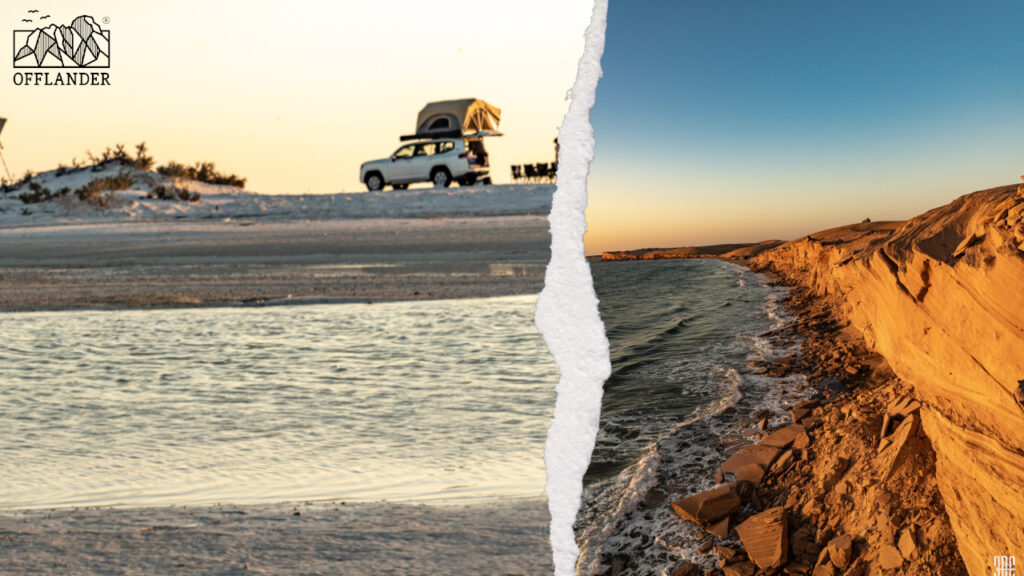
I wondered for a long time whether it was worth going so far north to Barr al-Hikman, because of all this nothingness, wasting so much time on transfers. But when I saw the white beach and the lagoon with two wooden buildings, I knew that this would be both the climax and turning point of our trip. With an emphasis on climax.
After visiting the buildings of the nearby campsite and the bar, which is supposedly a mecca for kiteboarding, we look for a place to camp. This time it is super easy and we have an excellent spot. On the left side we have the ocean about fifty meters away and on the right a mirror image in the form of a lagoon. We quickly set up and the whole team scatters around the area, everyone finds some pleasant activity. The children run on the ocean beach one moment, and the next moment catch crabs in the lagoon, dig in the white sand and collect countless shells and whatever the sea has spat out on the shore. The beach is clean and different from all the others, at least in Oman. There is a bath and rest. There is a sunset that melts into the ocean; in addition, a campfire and excellent company. We will soon burst with happiness. There are also a lot of birds, we observe seagulls, black herons and flamingos and large flocks of smaller birds, whose names I know. These are mainly active in the morning, which also did not disappoint. I get up well over half an hour before sunrise. I walk and look for the best shots in silence and total peace somewhere at the farthest end of the world.
After breakfast, we change the car wheel and also change our minds. Mario wrecked the first one in the village with a shop, on the curb. He was probably enchanted by the views of the dingy walls and chaos. We also change our plans, because we want to stay a little longer in this fantastic place, sacrificing another iconic place, which is Sugar Dunes. However, time, especially good time, passes quickly. So soon we are in the car and speeding along the gravel highway through the wastelands of Barr al-Hikman. We will not get a ticket here. We’re doing a hundred and forty on the straights, leaving a huge plume of dust behind us. But the ride. By the time we reach the next town, Hiji, our cars are covered in a fresh layer of light beige coating. The watchword is covering our cars again. We’re replenishing our supplies and honking a lot.
Honk
The word sounds strange in itself. However, Mariusz and I are starting to seriously abuse honking and it’s not about the alcohol, because we ran out a long time ago. I have literally a few milliliters of rum to celebrate the New Year and that’s only in a few days. Apart from Muscat and probably Salalah, you can’t buy it anywhere, in fact I didn’t manage to do it in Muscat either. I stood in line for a long time in a liquor store on the last day of our trip, in some dark district of Muscat, as the only white person. Around me were Hindus with a drinking license. Hindus usually have a strange and bloodshot look by nature, but here in this stuffy store everything took on different colors. And the smell of hot spices mixed with the smell of bare feet and sweat. After waiting for my turn, they asked me if I had a license. But what for, I’m eighteen, I say, but thank you for the compliment, regardless. The salesman says that without a license there is no alcohol, how to get it he doesn’t say anything. Nobody says anything, everyone just looks at me. Maybe someone will buy some for me, like when I was a minor? Something like buy a beer for grandpa because the lady won’t sell it to your grandson. One almost broke down, but he said he didn’t want to lose his license to honk.
We honk at gas stations, by cafes and even garbage cans. The culture and history of Oman are very interesting. For example, slavery was abolished in this country only in the seventies. There are also about two million native Omanis, and twice as many expats. Omanis are rich and usually have several, now paid, servants. Add to that the heat, it is normal for us to honk when we pull up to a gas station to get someone to fill up our tank. The same in many cafes, shops and restaurants. You pull up and honk, you don’t get out of the car. However, it is not tasty when Mario honks at me to throw out the garbage.
Sins
But he will pay for his sins quickly. Cruising along beaches, splashing water and driving with the PWR button pressed now and quite suddenly demands payment. Diesel is slowly dying.
Maybe I was luckier or maybe smarter… but probably definitely lucky. In petrol the air filter is on the right side, on the land side. In diesel on the left side, on the side of the salt water, which Mario sucked perfectly and evenly into the engine.
The filter is swollen and dirty, the engine compartment is covered with white salty sediment. We spend the next few days doing everything we can to clean the filter. We think it is to blame, that the horsepower is choking, can’t breathe, can’t run frivolously under the hood. There was soaking, brushing, blowing, picking, drying with the exhaust pipe, drying in the engine compartment. Washing with dishwashing liquid, washing in the ocean. We visited several repair stations and even a Toyota dealer, unfortunately no one had a filter. Then it turned out that they wouldn’t drive without a filter either, so the fault clearly lay in the poorly designed car by Japanese engineers. Somewhere they made a catastrophic mistake, for which we now had to pay.
We noticed the first symptoms when the petrol was going faster than the diesel. Or that afternoon, when we were driving up the cliffs above the ocean. Paradoxically, where we first soaked the cars in salt water. With great effort we climbed up the sandy cliff, in fact now that I think about it it could have been very bad, because the car with the rope had long since separated from us and we were stuck in the sand.
Turtles
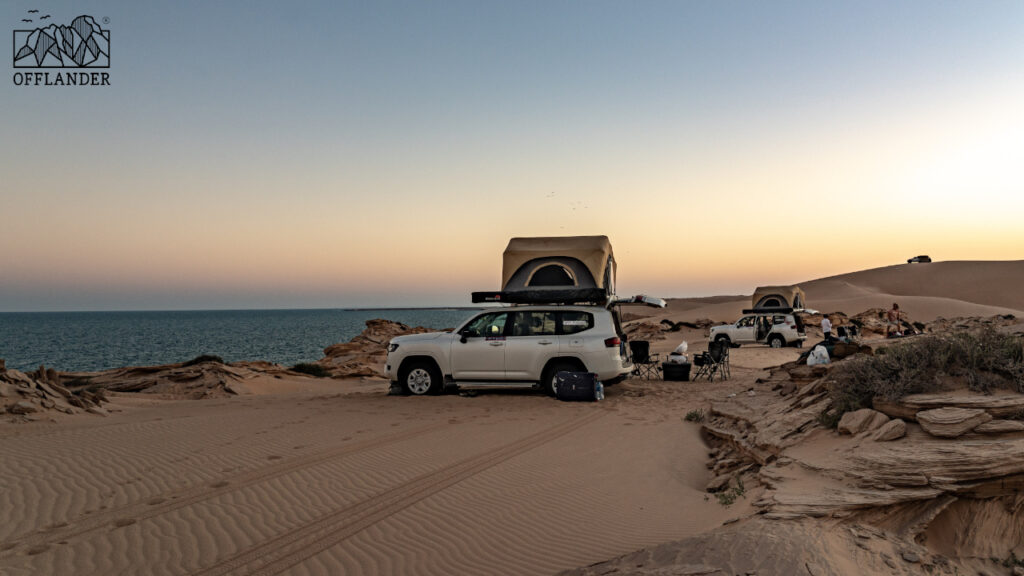
We didn’t let the rest of the days get ruined though. The diesel was slowly losing its power, but it kept going. We spent the last two nights on the coast in two completely different places. The first were the sand cliffs. Made of
sand rock, spectacular, golden and pleasing to the eye. However, we don’t sleep well there, most of the night the fishermen are out fishing. Dozens of small boats give off a strong smell of burnt diesel and there’s a general commotion. Despite everything, it was nice to watch it and realize how hard work it is. The morning, on the other hand, was excellent. The girls were doing yoga, the children were digging something in the sand, I was walking around the area. I was looking at the ocean and remembering what I could from the previous days. This second camp is a film set of a post-apocalyptic land. A flat cliff, like a table. Made of crushed rock glued together with smaller rock and soil. Falling vertically into the ocean. There is nothing, no vegetation, only a steep descent to the beach, where turtles lay their eggs and predators later steal them. The whole previous day we drove along the coast and in general, apart from an interesting meal in one of the restaurants, on the floor, there was nothing particularly fantastic. We have read a lot about Turtle Bay, so we are heading there. However, we did not find a good place to sleep there and quickly choose isolation. We return to the deserted cliff. The accumulation of tiredness, social frustration and our parting with the third car quickly chase us to bed. In the morning the landscape seems milder, as do our temperaments, especially mine. In the rays of the sun, in the morning we observe a few turtles, we all bathe in high foamy waves, and this worst camp turns
into the best in the blink of an eye. After breakfast we set off further north.
New Year
For several days I have been wondering how to choose a route to make this overnight stay exceptional, especially in comparison to the previous ones. We quickly pass through the city of Sur, after a dozen or so days of exile we are disgusted by civilization. The same thing happens with Wadi Bani Khalid, to which and from which we lose a lot of time to get there. The surfeit of cars on the road and the full
parking lot of tourists were already giving us all the signs that we should escape from here.
Soon we turn off the asphalt and traverse Wadi Wahlat. Rocky and dry with brown mountains in the background. Beautiful.
Later, Wadi Al Khabbeh awaits us, which does not seem to be anything special. Nevertheless, it gives us beautiful views, a lot of wood for a big New Year’s Eve bonfire, a ton of peace and isolation from anything. We chat by the bonfire, finish off a few long-saved sips of rum and sleep soundly around nine. We have more time in the morning, though. Yoga, walks, eggs for breakfast. Toilet from a bottle. Packing and on the road. Our morning standards.
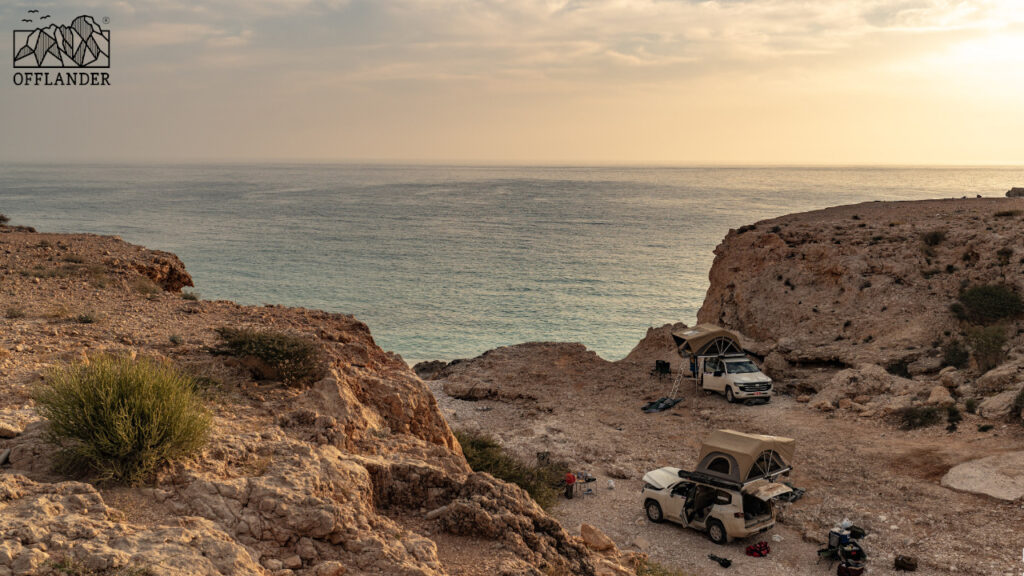
That day, tombs in the vicinity of Jebel Bani Jebir await us, arranged in high cones that look like large beehives. We witness the birth of a sheep on the road right in front of our car, which I barely slowed down when I saw a new creature being spat out of the sheep. We plan to drive to the Majlis Al Jinn cave and explore on ropes, but the road is blocked. With Mariusz’s car getting weaker and weaker, we give up on a possible crossing over the rocks and head back towards the coast, this time to the vicinity of Tiwi and Fins. We promise ourselves a walk in one of the nearby Wadi, but quickly decide to relax on a small beach that we had completely to ourselves. Access was difficult and we had to struggle a lot to finally get there. The entrance was so small that we had a problem fitting two cars on flat ground. Nevertheless, later it opened onto a fairly large beach, especially during low tide. The difference in water levels was about one and a half meters, so at the end of the day we admired crabs fighting with each other and shells stuck to the cliff walls. In the morning, the water was almost at our cars.
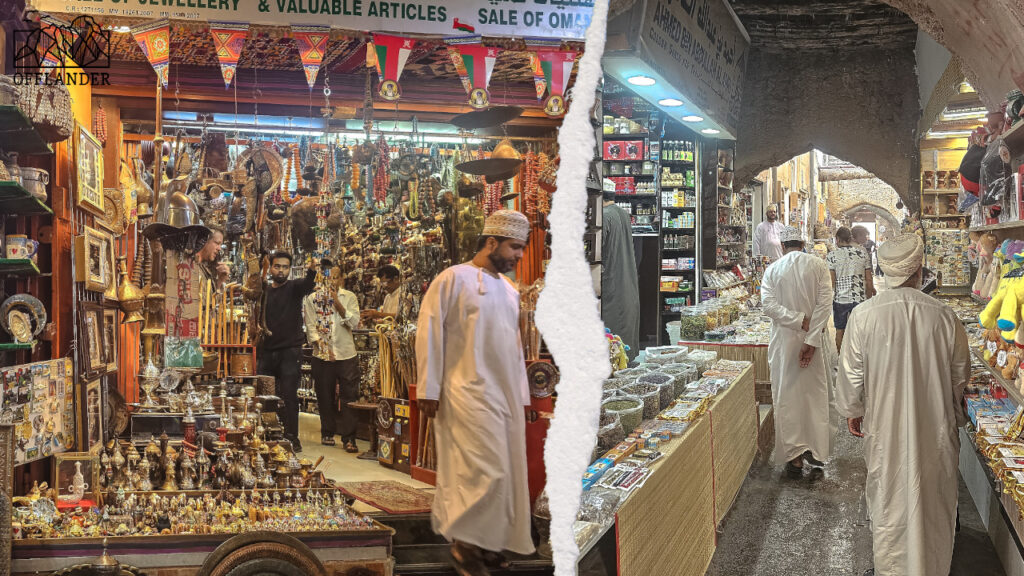
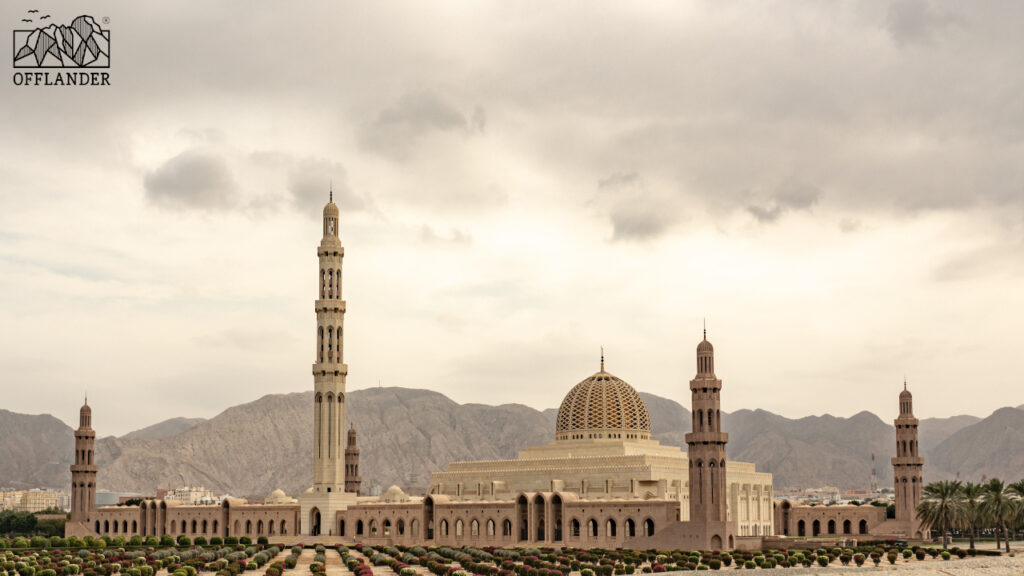
The last day and the whole team is falling apart. Mariusz’s family is waiting for rescue, the diesel has finally died. They are waiting for a replacement car. They let us go to Muscat on our own. We give up on further exploration over the mountains and go directly to the capital. There we try to get to the closed Grand Mosque of Sultan Qaboos. Later we visit the oldest souk in Muttrah, which is the biggest tangle of streets and stalls I have ever seen, even beating the souk in Marrakesh.
The next day we fly to Dubai, a concrete paradise. But that is another, less interesting story.
After writing this text, looking through photos and making videos, I know that Oman is one of the most interesting and diverse countries I have ever visited. You can find yourself in the desert and mountains in one day, or in the mountains and on the beach in one day. I highly recommend it.
We invite you to watch the film from this trip: